
Estimated reading time: 6 minutes
Effective Letter Recognition Strategies for Kids is the first of three blogs focusing on simple yet powerful strategies you can use at home with your child.
Are you looking for letter recognition strategies to help your child? Read on to learn about my go-to strategies for boosting letter knowledge.
Kindergarten students who fail to master letters and sounds can find themselves in a difficult uphill battle as letter naming predicts reading achievement (Adams, 1990 p. 358). If your child’s teacher is teaching one letter a week, I highly recommend incorporating a few of the strategies listed below to introduce more letters to your child.
In this blog, I will highlight key strategies for teaching letters and sounds to children. At the end, I will list free resources you can use at home.
Teach Uppercase Letters First to Improve Letter Recognition

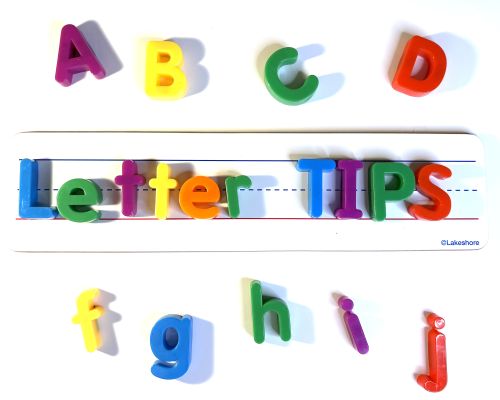
First, make uppercase letters your focus. Uppercase letters are easier to learn than lowercase letters. When providing therapy, I start with uppercase letters first. When first learning to write their names, many children print their names in uppercase letters. “Children ideally have the the opportunity to develop or consolidate letter identification with uppercase letters before lowercase letters are formally introduced because they contain fewer confusing letter shapes and are more graphically distinct” (Allen & Neuhaus, 2018, p.179). Use plastic letters for introducing letters. Plastic letters allow children to feel the shapes of the letters and engage multiple senses.
Once your child has mastered naming uppercase letters, move on to lowercase letters.
Letter Recognition Should Focus on Letters Whose Names Contain their Sounds
Next, you want to start with the easier letters first. If your child is struggling to name letters it is important to understand that all letters are not created equal. An effective letter recognition strategy is to focus on letters whose sounds are embedded in their letter names (Share, 2004, cited as in Honig, Diamond, and Gutlohn, 2018). Letters B, D, J, K, P, T, V, and Z contain their sound at the beginning of their letter name. Letters F, L, M, N, R, S, and X contain their sound at the end of their letter name. For example, each time your child says the letter “b” the sound of the letter is spoken at the beginning of the name.


Use Keywords to Promote Letter Recognition
In Beginning to Read: Thinking and Learning about Print(1990), Marilyn Adams explains that keyword and picture displays provide mnemonic assistance for letter shapes, letter sounds, and their couplings (p. 364).

My new concept lessons always begin with a review of a letter deck. The deck contains a target letter along with a picture. The routine begins with saying the name the letter, the corresponding keyword, and then the letter sound. When a student forgets a letter’s sound, I ask the student the letter’s keyword. The student names the word and identifies the sound. Each letter is represented by a key word that contains the letter’s sound in the initial position.
Keyword letter cards provide an additional layer of support for students who struggle with remembering letter names and sounds. Download and print my free set of keyword alphabet cards.
CLICK HERE FOR A SET OF FREE KEYWORD ALPHABET FLASHCARDS

Next Steps
Finally, if you have not received a parent report on which letters your child has not mastered, download and print my free letter recognition assessment. Equally important is knowing your child’s strengths and weaknesses with my quick alphabet assessment which will allow you to pinpoint where your child needs extra support in letter recognition. Uppercase letters, lowercase letters, and letter sounds are included in the free assessment.

In addition to my free letter recognition test, be sure to download a free set of alphabet flashcards.

CLICK HERE FOR A FREE SET OF ALPHABET FLASHCARDS
Letter Recognition Strategies: Part 2
In Part Two of my Letter Recognition Series, we’ll dive into additional hands-on activities that promote letter recognition.
Also Read:
Help Your Child Become A Better Reader
Works Cited
Adams , M.J. (1990). Beginning to read: thinking and learning about print. Cambridge, MA: MIT Press.
Birsh, J. and Carreker, S. (2018) Multisensory Teaching of Basic Language Skills, 4th Ed. Brookes Publishing: Baltimore, MD.
Allen, K. A. & Neuhaus G. F. (2018). Alphabet Knowledge: Letter recognition, letter naming, and letter sequencing. In Birsh, J. and Carreker, S. (Eds.), Multisensory Teaching of Basic Language Skills, 4th Ed. (pp. 171-203). Brookes Publishing.
Honig, B., Diamond, L., and Gutlohn, L. (2018). Teaching Reading Sourcebook, 3rd Ed. Arena Press.
Key Takeaways
- Letter Recognition Strategies Part 1 offers effective methods to help children learn letters at home.
- Start by teaching uppercase letters first, as they are easier for children to recognize.
- Focus on letter names that include their sounds to improve recognition and recall effectiveness.
- Use keywords with pictures to aid memory of letter shapes and sounds, enhancing learning support.
- Free resources like letter recognition assessments and keyword alphabet cards are available to assist further.
Leave a Reply